Saturday, April 25, 2009

The Kent Hotel Video Remix

Here's a video I made with stills from my photo-shoot at The Kent Hotel last week.


This Miami Beach landmark on Collins Avenue was designed by architect L. Murray Dixon in a streamlined Art Deco style in 1939 and was recently renovated.

Photos from the shoot will be used in the hotel's new website and other advertising collateral.

The music is by the great Cuban Mambo king Perez Prado from a circa 1952 video clip found on YouTube. And my photo assistant on the shoot was Adam Dalziel.

Labels: , , , , , , , , ,

Thursday, February 21, 2008

Doorways in Time


Back in the 1930s and '40s, before air-conditioning was commonplace, most houses in Miami Beach had screen doors -- beautiful Art Deco screen doors.

Though South Beach's historic district is supposed to be protected from changes that destroy its unique character, quite a few of the elegant old doors have disappeared during the last 15 years.

I think many rusty or broken ones were simply junked by owners who didn't recognize their value.


Others, however, remain; and some have even been restored.

Illustrated here are three old ones that remain in or near Miami Beach's now booming South Pointe area

When I first saw this neighborhood at the southern tip of Miami Beach, back in 1992, it was a slum; and many old cottages, small apartment buildings and little hotels were in ramshackle disrepair alongside a few that hip entrepreneurs had fixed up. Now the neighborhood has been revived with ultra high-end, high-rise condos ringing the waterfront; and some of the older buildings have been lost. Many still remain, though, along with their remarkable doors.


I made these pictures yesterday afternoon with a little Canon G9 that when I'm not shooting professionally with my big cameras, I carry with me everywhere.

Labels: , , , , ,

Tuesday, November 06, 2007

Sleepless in Miami


Saturday night Miami Beach was more interesting than usual with art installations and live performances all over town nearly until dawn -- part of what was billed as a $400,000 "Sleepless Night" of culture.

Hookers were still click-clacking in their heels on Collins Avenue; and clueless teenagers, hip-hoppers and twenty somethings were still lining up to get into overpriced clubs on Washington guarded by hulking bouncers in suits -- a far cry from the glorious times of yesteryear (some 15 years ago) when the clubs were still cool, the crowds hipper, and achingly beautiful women in drop-dead gowns or drag queens in wings -- door goddeses they were called -- guarded the doors, deciding who'd get in.

Anyhow, the lure of the neon got to me, so I took some fast lenses (a 50mm f1.4; a 28 f1.8; and a 135mm f2) plus a 17- megapixel Canon 1Ds Mk3, and walked about for couple hours.

I shot architecture more than people -- though there were some cute kissing couples in Plaza de España, where Dana Keith's great Miami Beach Cinematheque put on an outdoor showing of the 1929 Surrealist classic Un Chien Andalou accompanied by a live performance of a flamenco troupe.

Even so, it was the architecture, the approximately 70-year-old Art Deco architecture, that drew me the most; and I photographed it handheld, mostly with the 28mm wide-angle, and then made the perspective more rectalinear in Photoshop, adjusting away distortion and making the lines more true.

The Sigma lens, the 28, is big and heavy, and I didn't think it would be very sharp wide open -- but it was, and yet had a creamy quality, abetted by some High Dynamic Range post-processing I dd in Photoshop.

I hadn't shot with my fast lenses for a long time -- I've been using f2.8 and f4 zooms and tilt-shift lenses mostly. But this was a return to my roots: I used to do photojournalism with a fast 50, a 28, and a 135; I love those focal lenghts.

Labels: , , , , , , , ,

Saturday, June 30, 2007

"The Most Beautifiul Pool in Florida"


In 1940, as America teetered on the brink of a catclysmic World War, several luxurious Art Deco hotels were placed on Miami Beach's Collins Avenue like a string of gleaming pearls on a necklace. One of the most luminescent of these architectural gems was The Raleigh Hotel, designed by L. Murray Dixon.

The hotel's most magnificent features are the intimate Martini Bar and a spectacular swiming pool.

I first photographed the famous Raleigh pool around 1993 for the now defunct South Florida Magazine:
This photograph from that shoot later appeared in many magazines around the world, as well as in my book South Beach, America's Riviera, and in the Miami Design Preservation League's Miami Beach Architectural Guide

In 2002, one of the most astute hoteliers of our day, André Balazs, bought the hotel from a South Beach revival pioneer, Kenny Zarrilli, who had made The Raleigh emblematic of the Miami Beach renaissance, filling it with fashion shoots and hipsters in the 1990s. Ten years later Balazs polished Zarrilli's somewhat funky Raleigh into something even more chic.

Recently, one of The Raleigh's sales executives came across my 1993 picture in Switzerland, and asked me to update my photograph to show the pool and pool area as it looks today. So last week I rephotographed the pool for about an hour from the wrap-around balcony of The Raleigh's penthouse -- a rather spectacular perch.


In the 1940s Life magazine hailed The Raleigh's pool as "the most beautiful in Florida." Some say it still is.

When I processed my raw files from this shoot in Adobe's Photoshop CS3, I interpreted the colors to be a little warmer than they actually seemed to the camera at mid-day (the camera made everything too blue). Then I opened up the shadows quite a bit and burned in some highlights. Next I worked to make my colors reminiscent of those I see in vintage postcards. I also converted some of my images into black-and-whites, and then into duotones: a little blue in the shadows plus a little rose in the highlights, and then a little platinum gray everywhere.


In the era of chemical-based photography, I would have made many of these adjustments mechanically in the old-fashioned, wet darkroom, by manipulating with my hands the amount of light falling from the enlarger onto the light-sensitive paper, or by washing the print in various chemical solutions. Nowadays, I do the equivalent of all that and more in my computer, in the virtual workspace of "the digital darkroom."

Many people seem to believe photography is a completely literal and realistic medium -- as if the camera were a perfectly objective mechanical eye, a conclusive truth-recording machine.

But from its very beginning, photography has always been an interpretive art, and every photo is merely a representation of reality, not reality itself.

So many choices and limitations are inherent in the tools:

The optics, the filters, perspective adjustment, timing -- and countless other technical and compositional choices make the entire process of capturing, processing (or "developing"), and then printing the image intensely, hopelessly, subjective.

The more skilled the practitioner . . . the more he or she controls or doesn't control the camera, the saturation, the colors, the contrast, the composition, and so forth . . . the more personal it all is. Even photojournalism, where blatant retouching of the sort so common in advertising or fashion would be unethical, nonetheless has intensely subjective aspects inherent in the artistic choices so inescapable in the photographic process itself.

As Picasso said in a different context: "Art is a lie that tells the truth." And putting three-dimensional, moving, noisey, fragrant reality into a two-dimensional medium of shapes and colors is always an approximation, a recreation, an interpretation.


Labels: , , , , , , ,

Monday, July 24, 2006

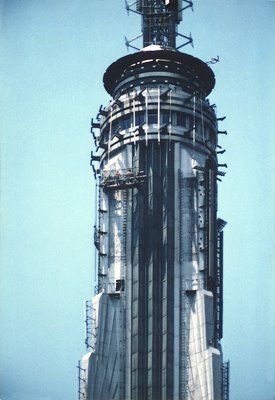
The Empire State Building


Until I was seven years old, I lived only a few blocks from this great building -- it literally loomed large in my childhood, and I used to love to ride the elevators to the top and look at the city spread out below. It was the tallest building in the world back then. I still love photographing it from every angle. This was done with a 1,000 mm lens.

Labels: , , , , , , , , , ,

The Death of the Charles Hotel


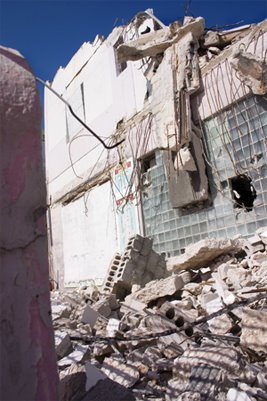
Walking on Miami Beach's Collins Avenue today, I remembered the now-vanished Charles Hotel, a Deco gem built in 1938, but demolished in 2004 -- even though it was in a supposedly officially protected historic preservation district.


The owner seemed to let it deteriorate until it was deemed structurally unsound and he could get official permission to knock it down. Now a not-bad, post-modern, low-rise condo building has been erected on the spot.


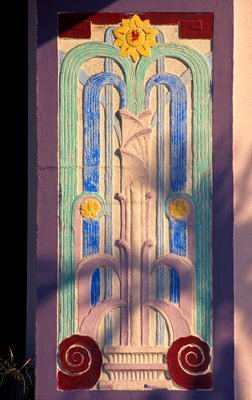
But the Art Deco panels -- some of the best bas-reliefs in South Beach -- that decorated The Charles are gone forever. Here's what they looked like. The first picture is of the north wall; the closeup is of a more or less identical panel on the west wall, beside what was the main entrance to the Charles Hotel.

Labels: , , , , , ,